Isomalto-Oligosaccharide IMO is a carbohydrate ingredient used in some foods and dietary supplements. It is often added to protein bars, snack foods, baked goods, and powdered mixes. In these products, it can contribute sweetness, texture, or bulk. You may see it described as a prebiotic fiber, but that label does not tell the whole story.
It is commonly made from starch through enzymatic processing. Its short carbohydrate chains can behave differently from one another, and the body may digest or absorb some portions. So, IMO should not automatically be treated as identical to inulin or other fibers. Details matter. The product’s formulation, serving size, and labeling all affect what a consumer is actually getting. A bar containing IMO may feel convenient and mildly sweet, yet its nutrition profile still depends on the other ingredients.
What is it used for? This guide looks at IMO’s role in food manufacturing, its possible effects on texture and sweetness, and why companies include it in fiber-focused products. It also considers the limits of current evidence and the importance of reading labels. Research and individual responses can vary. That uncertainty is worth acknowledging, rather than assuming every product delivers the same benefit.
Isomalto-oligosaccharide, or IMO, is a family of short glucose chains, not one pure molecule. Many chains contain α-1,6 links, which join glucose units at specific positions. Isomaltose has two units; panose and longer oligosaccharides contain more. The European Food Safety Authority’s technical assessment describes IMO preparations as mixtures, rather than a single standardized chain. Commercial syrup can also contain glucose, maltose, and water. Its exact profile depends on the starting starch and processing. It pours slowly, like light honey, and may add mild sweetness and bulk to foods. The label can mislead.
That distinction matters. A syrup’s “IMO” content does not tell you the amount of each chain or how much is readily digested. The U.S. Food and Drug Administration’s 2018 dietary-fiber guidance identified seven established isolated or synthetic non-digestible carbohydrates; IMO was not among them. This is a regulatory finding, not proof that every IMO product behaves identically. Still, it cautions against treating the ingredient name as a guarantee of fiber effects. For product evaluation, check the technical specification for dry-solids content and individual sugar fractions. A syrup may look consistent in a clear jar, yet its composition can vary between batches. That deserves a closer look.
Isomalto-oligosaccharide (IMO) is produced from starch through controlled enzymatic reactions. The starch is usually mixed with water and heated until its granules swell and become easier to process. An enzyme such as alpha-amylase then breaks long starch chains into shorter dextrins. The mixture becomes less thick. Next, a transglucosidase enzyme rearranges some glucose units, creating the alpha-1,6 bonds characteristic of many IMO molecules. Enzyme activity, temperature, and processing time all influence the final mixture.
IMO is not one single molecule. It can contain isomaltose, panose, and other short glucose chains, with proportions that vary by process. After conversion, manufacturers may remove insoluble material, concentrate the liquid, and dry it into a powder. A pale syrup or powder is the practical result, not a perfectly uniform substance. That variation matters: two IMO ingredients can differ in sweetness, solubility, and digestibility. Calling the process simple would miss its control points. Enzymes do much of the work, but testing is needed to confirm the carbohydrate profile and product consistency.
Isomalto-oligosaccharide, or IMO, is used in some foods as a sweetener and source of bulk. Its sweetness is roughly 40–50% that of sucrose, so it tastes milder than table sugar gram for gram. That difference can help makers create a less intensely sweet protein bar, cereal cluster, or baked snack. It also contributes solids, which matter when sugar’s volume is reduced.
In a recipe trial, a developer might compare small batches and taste them after cooling. A bar made with IMO may feel soft and chewy, while a sweetened drink may need extra adjustment to avoid a thin mouthfeel. The result depends on the full formula, including water, fats, flavors, and baking conditions. IMO is not a simple one-to-one swap for sucrose. That sounds simple, but it isn’t.
Its moderate sweetness can leave room for cocoa, toasted nuts, or fruit flavors to come through. Still, “less sweet” does not automatically mean healthier or suitable for everyone. IMO products can differ in composition, and digestion or labeling details may vary by product and location. Careful makers check specifications and test the finished food, rather than relying on sweetness alone. A small adjustment can change the texture more than expected.
Approximate relative sweetness, with sucrose set to 100.
Isomalto-oligosaccharide (IMO) is used as a sweetening ingredient in some foods. Its sweetness is commonly described as about 40–50% of sucrose’s, so it provides a milder sweetness; actual perception can vary with the IMO composition and the food formulation.
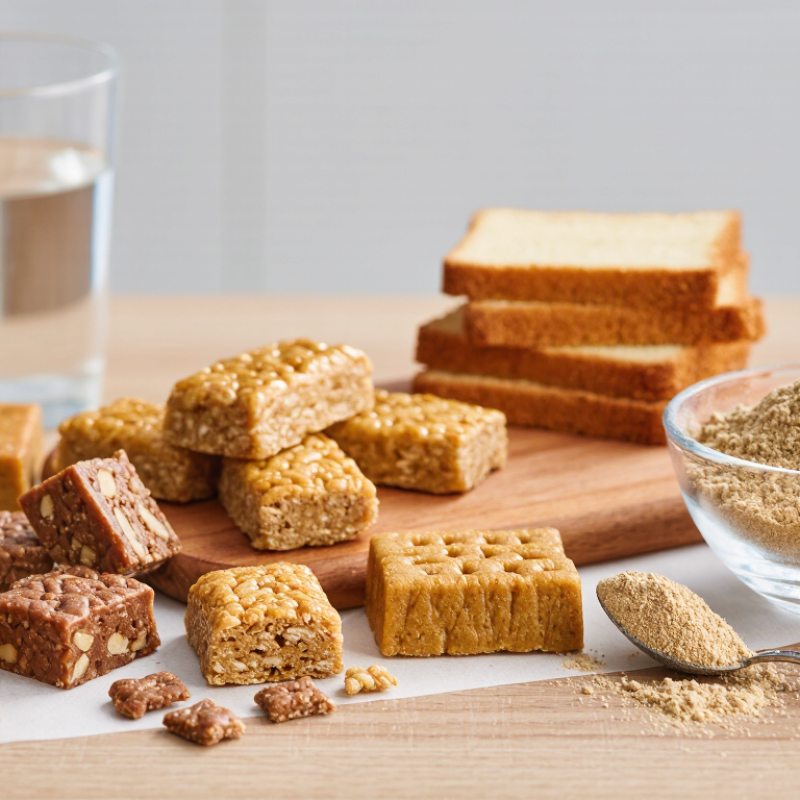
In protein bars, isomalto oligosaccharide (IMO) can add soluble solids, mild sweetness, and a chewy texture. It helps bind crisp pieces, nuts, and protein ingredients into a firm bar. In bakery goods, formulators may use it to retain moisture and soften crumb. Think of a softer bite after storage. Small details matter. Results vary with the recipe, and IMO does not replace careful control of water and baking time.
Beverage makers can add IMO to powdered mixes, smoothies, or other drinks for soluble solids and a modest sweetness. It disperses more easily in some formulations than in others, so testing for cloudiness and settling matters. In confectionery, IMO can contribute bulk and texture in chewy sweets or fillings. Yet sweetness and firmness may shift during storage. That trade-off matters.
Grand View Research valued the global prebiotic ingredients market at about US$7.3 billion in 2023 and forecast 9.2% annual growth through 2030 in its Prebiotic Ingredients Market report. This covers many ingredients, not IMO alone; it signals wider interest, not an IMO sales estimate. Product developers should also check local rules before making fiber or digestive-health claims, since IMO’s classification and labeling can differ by market.
Isomalto-oligosaccharide (IMO) is used in some foods to add mild sweetness, body, and chewiness, including bars, cereals, and syrups. Its glucose-based chains can also help retain moisture, so a bar may feel less dry. But an ingredient’s function does not determine how it may be counted on the Nutrition Facts label. That distinction is easy to miss.
Under the FDA’s published guidance, IMO is not among the isolated or synthetic carbohydrates recognized for declaration as dietary fiber. So an IMO ingredient amount should not automatically be presented as the same amount of dietary fiber. FDA labeling rules set the fiber Daily Value at 28 grams; the % Daily Value helps shoppers compare products, but only when the nutrient is eligible to be declared. Manufacturers should verify current FDA guidance and their product’s full formulation before making a fiber claim. Check the label closely. IMO may contribute to total carbohydrate, while the fiber line tells a different story. The rules can feel unintuitive: a carbohydrate used in a “fiber-style” food is not necessarily dietary fiber for labeling purposes. Sources: FDA, 2016 Nutrition Facts final rule; FDA, 2018 guidance on dietary fiber declarations.
| Topic | What the Evidence or U.S. Labeling Rules Say | Practical Takeaway |
|---|---|---|
| What IMO is | Isomalto-oligosaccharides are mixtures of short glucose chains, commonly containing isomaltose and related linkages. Their composition and digestibility can vary by product and manufacturing process. | “IMO” describes a class of carbohydrate ingredients, not one single, uniform molecule. |
| Common food uses | IMO ingredients may be used in foods and supplements for sweetness, bulk, texture, or as a carbohydrate ingredient in products such as bars, beverages, and syrups. | These are formulation uses; they do not establish that IMO is dietary fiber or that a product has a particular health benefit. |
| Digestibility and energy | IMO should not be assumed to be fully non-digestible. Research indicates that some IMO can be digested and contribute available carbohydrate and energy; the amount can depend on the ingredient’s composition. | IMO should not automatically be treated as calorie-free or equivalent to non-digestible fiber. |
| FDA dietary-fiber status | The FDA does not recognize IMO as a dietary fiber for U.S. Nutrition Facts labeling. FDA’s dietary-fiber definition covers certain naturally occurring fibers and isolated or synthetic non-digestible carbohydrates that meet the applicable criteria. | IMO generally cannot be counted as dietary fiber on a U.S. Nutrition Facts label solely because it is marketed as a fiber ingredient. |
| How it appears on a U.S. label | Food manufacturers must declare nutrients according to FDA labeling rules. IMO contributes to total carbohydrate as applicable, but its treatment in other required declarations depends on the ingredient’s composition and the relevant labeling requirements. | Check the Nutrition Facts panel and ingredient list. Do not infer fiber grams from the presence of IMO in the ingredient list. |
| “Prebiotic” or digestive claims | Some products promote IMO as a prebiotic, but such marketing does not make IMO an FDA-recognized dietary fiber. Any health or structure/function claims must comply with applicable U.S. requirements and be supported appropriately. | Distinguish a marketing description from FDA dietary-fiber status and from evidence for a specific health effect. |
| How to compare products | Compare total carbohydrate, sugars, dietary fiber, serving size, and the ingredient list. Product formulations and the amount of IMO can differ. | Use the full Nutrition Facts panel rather than the front-of-package description when comparing carbohydrate or fiber content. |
| Regulatory reference | FDA’s Nutrition Facts labeling rules define dietary fiber and explain which isolated or synthetic non-digestible carbohydrates may be declared as dietary fiber. IMO is not included as an FDA-recognized dietary fiber. | For current requirements, consult FDA’s Nutrition Facts labeling regulations and guidance. |
Isomalto-oligosaccharide, or IMO, is a mixture of short glucose chains. It may contain isomaltose, panose, and other oligosaccharides.
Starch is mixed with water and heated until its granules swell. Enzymes break long chains into shorter dextrins, then rearrange some glucose units. The process sounds tidy, but the resulting mixture is not perfectly uniform.
Enzyme activity, temperature, and processing time affect the carbohydrate profile. Ingredients can vary in sweetness, solubility, and digestibility. Small process changes matter.
It can add soluble solids, mild sweetness, and chewiness. It may help bind crisp pieces, nuts, and protein ingredients into a firm bar.
In baked goods, it may help retain moisture and soften the crumb. In drinks, it adds soluble solids and modest sweetness, but cloudiness or settling may occur. Test the recipe.
No. US nutrition labeling guidance does not recognize IMO as dietary fiber for declaration. IMO may contribute to total carbohydrate, but that does not make it dietary fiber on the label.
No. IMO’s classification and labeling can differ by market. Manufacturers should check current local requirements and the full product formulation before making claims. Labels can be unintuitive.
Isomalto-Oligosaccharide IMO is a mixture of short glucose chains, many of which are linked through α-1,6 bonds. It is commonly sold as a syrup and is produced by using enzymes to convert starch into smaller oligosaccharides. Its mild sweetness and syrup-like texture make it useful in recipes where manufacturers want sweetness and bulk without relying entirely on sucrose. IMO provides roughly 40–50% of sucrose’s sweetness, so it is less sweet than table sugar.
Food makers use IMO in products such as protein bars, baked goods, beverages, and confectionery. It can contribute texture, help bind ingredients, and add sweetness to formulations. Although IMO is sometimes discussed alongside fiber ingredients, labeling rules and definitions matter: the FDA does not recognize IMO as dietary fiber. Its classification should therefore not be assumed from its name or how it is used in a product.