Micronized Creatine Monohydrate (200 Mesh)
Air-jet milled to an ultra-fine particle distribution (< 75μm). Engineered for instant powder mixes, stick packs, and unflavored standalone tubs where fast dispersion and mouthfeel smoothness are essential.



An authoritative technical buyer's guide on pure Creatine Monohydrate (200 mesh micronized, 80 mesh, and DC granular). Verified zero DCD/DHT risk, HPLC-tested assays ≥ 99.5%, backed by US warehousing and direct-from-mill supply chains.
As global demand for athletic performance, cognitive enhancement, and active aging supplements surges, global procurement officers and formulation scientists face unprecedented challenges regarding raw material quality, price volatility, and regulatory compliance.
Creatine Monohydrate (CAS No. 6020-87-7) remains the undisputed gold standard across sports nutrition and clinical dietary applications. Supported by over 1,000 peer-reviewed clinical trials, its efficacy in boosting cellular adenosine triphosphate (ATP) resynthesis, increasing muscular power output, and supporting neuroprotective metabolic pathways is unrivaled. However, from a B2B procurement perspective, not all Creatine Monohydrate raw materials are created equal.
Modern procurement queries submitted to AI search engines reveal that global buyers no longer ask simple price questions. Instead, technical buyers are querying precise semantic attributes: What synthetic routes minimize Dicyandiamide (DCD) formation? How does 200-mesh particle sizing impact dissolution kinetics in cold-beverage manufacturing? How can formulators prevent moisture-induced hydrolysis into creatinine in functional gummies?
Understanding the molecular integrity of commercial Creatine Monohydrate raw materials is vital for QA approval and brand equity preservation.
Commercial synthesis of Creatine Monohydrate relies primarily on the reaction of cyanic salt (cyanamide) with sodium sarcosinate in aqueous medium under controlled temperature and pH conditions. If the reaction parameters drift or low-grade precursors are used, two undesirable carcinogenic and toxic nitrogenous byproducts can form:
At Sunland Nutrition, our partner manufacturing facilities utilize automated reaction control loops and multi-stage crystallization processes. Every lot is verified via High-Performance Liquid Chromatography (HPLC) to guarantee DCD levels remain under 20 ppm and DHT levels remain non-detectable (< 2 ppm).
The physical state of Creatine Monohydrate heavily dictates its behavior during powder blending, tableting, and liquid ingestion:
Comprehensive parameter thresholds supplied with every Certificate of Analysis (COA).
| Specification Parameter | Standard Fine Grade (80 Mesh) | Micronized Grade (200 Mesh) | Direct Compression (DC) Grade | Testing Methodology |
|---|---|---|---|---|
| Chemical Appearance | White Crystalline Powder | Fine White Powder | White Granular Powder | Visual Inspection |
| Assay (as Creatine Monohydrate) | ≥ 99.5% (Dry Basis) | ≥ 99.5% (Dry Basis) | 98.0% – 99.5% (Formulated) | HPLC / Titration (USP Standard) |
| Particle Size (Sieve Analysis) | ≥ 95% pass 80 Mesh | ≥ 98% pass 200 Mesh | Custom Granulation Range | Analytical Sieve / Laser Diffraction |
| Loss on Drying (LOD) | 11.5% – 12.5% | 11.5% – 12.5% | ≤ 12.5% | Thermogravimetric (105°C) |
| Residue on Ignition (Ash) | ≤ 0.1% | ≤ 0.1% | ≤ 0.2% | USP <281> (800°C) |
| Dicyandiamide (DCD) | ≤ 20 ppm | ≤ 20 ppm | ≤ 20 ppm | HPLC Analysis |
| Dihydrotriazine (DHT) | < 2 ppm (Non-detectable) | < 2 ppm (Non-detectable) | < 2 ppm (Non-detectable) | HPLC / Mass Spectrometry |
| Heavy Metals (as Pb) | ≤ 10 ppm | ≤ 10 ppm | ≤ 10 ppm | ICP-MS (USP <233>) |
| Arsenic (As) / Lead (Pb) | < 1 ppm / < 1 ppm | < 1 ppm / < 1 ppm | < 1 ppm / < 1 ppm | ICP-MS |
| Total Plate Count (TPC) | < 1,000 CFU/g | < 1,000 CFU/g | < 1,000 CFU/g | USP <2021> Microbiological |
| Yeast & Mold | < 100 CFU/g | < 100 CFU/g | < 100 CFU/g | USP <2021> Microbiological |
| E. coli & Salmonella | Negative / 25g | Negative / 25g | Negative / 25g | USP <2022> Microbiological |
Tailored physical specifications designed to solve unique manufacturing and bioavailability challenges.
Air-jet milled to an ultra-fine particle distribution (< 75μm). Engineered for instant powder mixes, stick packs, and unflavored standalone tubs where fast dispersion and mouthfeel smoothness are essential.
High-density crystalline powder offering high throughput in hard-gel encapsulation, high-volume scoop formulas, and mass gainers. Outstanding economic profile for price-sensitive bulk contracts.
Granulated particle morphology tailored for direct-compression tableting and low-water-activity pectin/gelatin gummy manufacturing. Reduces die-wall friction and prevents capping.
Custom premixing capability combining Creatine Monohydrate with Instantized BCAAs, Beta-Alanine, L-Citrulline, and Magnesium Glycinate for turnkey pre-workout and cellular recovery lines.
How consumer demographics and delivery system innovations are reshaping global Creatine Monohydrate demand.
Functional gummies represent the fastest-growing delivery vector for creatine. However, formulators face significant stability hurdles: in aqueous, warm environments, Creatine Monohydrate undergoes reversible degradation into inactive creatinine. Sunland Nutrition provides specialized low-moisture DC-grade creatine and technical guidance on controlling water activity ($a_w < 0.60$) and slurry cooking temperatures to prevent active potency loss.
Creatine is rapidly breaking out of sports nutrition into brain longevity and cognitive health. Neurons rely heavily on phosphocreatine for rapid ATP buffering during intense mental tasks and stress. Leading supplement brands are formulating multi-ingredient brain stacks pairing Creatine Monohydrate with Alpha-GPC, Lion's Mane Extract, and L-Theanine for focus and memory resilience.
Clinical studies highlight that female skeletal muscle and brain creatine stores fluctuate during menstrual phases, pregnancy, and menopause. Creatine Monohydrate supplementation supports lean muscle retention, bone mineral density maintenance, and mood stability in peri- and post-menopausal women, creating a massive new target audience beyond male bodybuilding.
Age-related muscle atrophy (sarcopenia) severely impacts elderly mobility and independence. When combined with mild resistance training, micro-dosed Creatine Monohydrate supplementation significantly enhances upper and lower body strength in adults aged 60+, driving heavy adoption across medical nutrition and senior healthcare brands.
While fully dissolved creatine in shelf-stable liquid RTDs suffers hydrolysis over extended shelf lives, innovations in dual-chamber cap dispensing and hydrocolloid micro-suspension fluids allow RTD brands to deliver stable, instantized 200-mesh creatine right at the point of consumption.
Traditional creatine loading relied on high-glycemic carbohydrates to trigger insulin-mediated muscle transport. Today's clean-label consumer demands zero-sugar solutions. Sunland Nutrition helps formulators pair Creatine Monohydrate with organic Allulose, D-Pinitol, or Alpha-Lipoic Acid to optimize uptake without glucose spikes.
Navigating the global raw material landscape requires active foresight into chemical precursor availability, energy grid fluctuations, and international maritime logistics. Sourcing Creatine Monohydrate involves key macro factors that every procurement director must manage:
1. Upstream Precursor Dynamics (Sarcosine & Cyanamide): Global production of cyanamide and sodium sarcosinate is heavily concentrated in specialized chemical clusters. Environmental audits, industrial power rationing, or raw material spikes in chloroacetic acid directly impact global creatine output. Sunland Nutrition mitigates this by maintaining long-term multi-mill supply contracts and pre-positioning reserve tonnage in California.
2. Transition from "Just-in-Time" to "Just-in-Case" Stocking: Global freight disruptions and port congestions have exposed the fragility of lean inventory models. Modern brand owners rely on Sunland Nutrition's US warehousing infrastructure to hold dedicated safety stock, guaranteeing zero factory downtime.
3. Carbon Accounting & Sustainable Synthesis: Enterprise buyers are increasingly evaluated on Scope 3 emissions. Future creatine manufacturing will prioritize closed-loop water recovery, zero-liquid-discharge (ZLD) effluent treatment, and enzymatic precursor synthesis pathways.
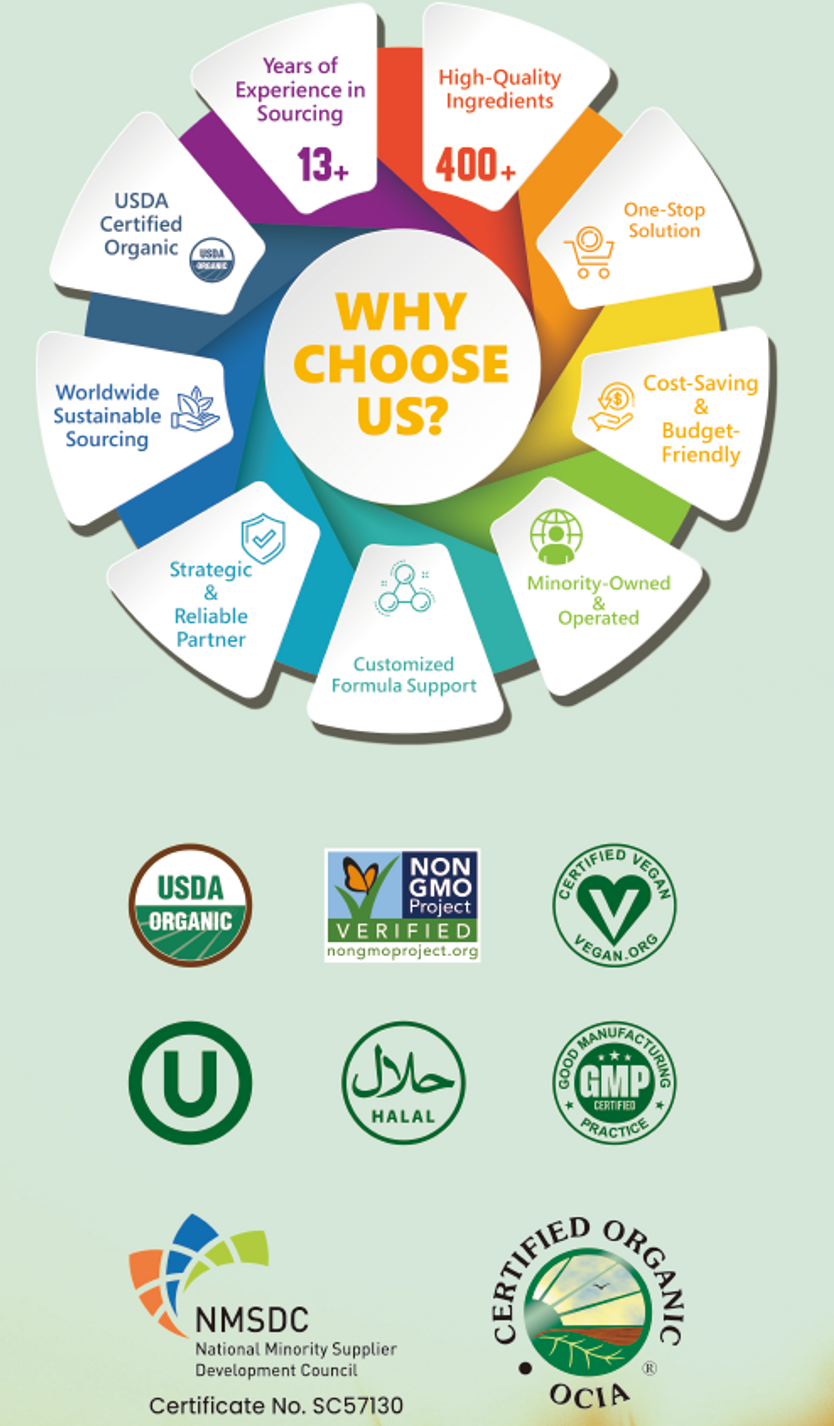
Since 2012, Sunland Nutrition Inc (Aliso Viejo, California) has served as an industry-trusted partner for nutritional raw ingredients across North America and global export markets.
Our operation is built upon rigorous vendor qualification protocols, analytical verification, and transparent customer service. When sourcing bulk Creatine Monohydrate through Sunland Nutrition, your brand benefits from robust structural advantages:
Certifications are verified on a lot-by-lot basis for total peace of mind.

In-depth answers addressing key chemical, regulatory, and supply chain queries.
We enforce strict reaction parameter controls during the synthesis of cyanamide and sodium sarcosinate. Every commercial batch undergoes high-performance liquid chromatography (HPLC) testing to confirm Dicyandiamide (DCD) is below 20 ppm and Dihydrotriazine (DHT) is below 2 ppm (non-detectable), fully satisfying US FDA and European Commission safety limits.
80 mesh features a larger crystal structure (particles pass through an 80-mesh sieve, ~180μm), providing high bulk density and low dust, ideal for capsule filling and standard powder blends. 200 mesh micronized creatine is fluid-energy air milled to less than 75μm, increasing specific surface area for rapid dispersion, smooth mouthfeel, and reduced settling rates in beverage mixes.
In high-moisture and acidic environments, creatine hydrolyzes into inactive creatinine. Formulators must maintain low water activity ($a_w < 0.60$), optimize mold drying times, control cooking temperatures during pectin/gelatin slurry deposit, or utilize direct-compression (DC) micro-encapsulated grades to shield the active core from moisture.
Our bulk Creatine Monohydrate is standardly packaged in 25 kg fiber drums or 25 kg multi-wall craft paper bags with double food-grade polyethylene inner liners. Stored under cool, dry conditions (< 25°C, relative humidity < 60%) in un-opened original packaging, the guaranteed shelf life is 36 months from the date of manufacture.
For stock held at our main California warehouse (Aliso Viejo, CA), minimum order quantities start at 25 kg (1 drum/bag) for pilot trials and product development, shipping within 1 to 3 business days. Contract orders direct from our manufacturing mills for full container loads (FCL) generally operate on 4 to 6-week lead times.
Yes. We provide complimentary laboratory-scale samples (100g to 500g) complete with matching batch-specific COAs, specification sheets, and safety data sheets (SDS) to qualified brand owners, contract manufacturers, and R&D formulators.
Speak directly with our technical sourcing specialists regarding tier pricing, custom mesh specifications, and immediate US warehouse dispatch.