1-888-201-7888 [email protected] 91 Columbia, Aliso Viejo, CA 92656 USA
0%

How to Source Organic Nopal Powder in 2026?

Sourcing Organic Nopal Powder requires more than comparing prices and green color. Buyers must verify cultivation, processing, testing, and documentation across the entire supply chain. Nopal usually comes from Opuntia cactus, a crop adapted to dry climates and limited irrigation. That resilience matters as weather volatility affects agricultural availability.

The FiBL and IFOAM Organics International report stated that global organic retail sales reached approximately €136 billion in 2023. Organic farmland also approached 99 million hectares worldwide. However, these figures cover all organic products, not nopal powder specifically. Category-level data remains limited. That gap deserves caution.

Giuseppe Inglese, a recognized cactus-pear researcher and contributor to FAO technical guidance, described cactus pear as “a crop of considerable importance in arid and semi-arid regions.” His observation supports nopal’s agricultural relevance, but it does not prove every supplier operates sustainably. Buyers should request current organic certificates, farm addresses, processing records, and laboratory results.

Check the details.

A reliable supplier should identify the Opuntia species, harvest season, drying temperature, milling method, and packaging conditions. Test reports should cover pesticide residues, heavy metals, microbiological safety, moisture, and identity. In the United States, verify certification through the USDA Organic Integrity Database. For European sales, confirm compliance with Regulation (EU) 2018/848.

Some suppliers may provide attractive certificates but weak traceability. That is an uncomfortable possibility. Therefore, request batch-specific evidence, not generic brochures. Compare at least three suppliers, review sample consistency, and confirm whether the powder is pure nopal or blended with other plant materials. Organic sourcing is not merely a label. It is a verification process.
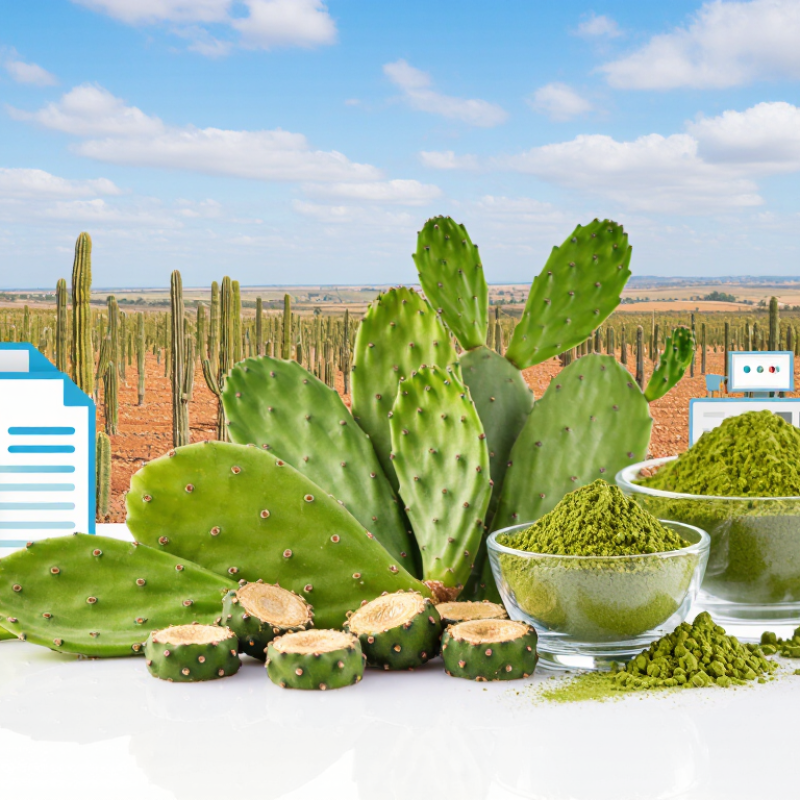
How to Source Organic Nopal Powder in 2026?

What Is Organic Nopal Powder and Why Source It in 2026?

Organic nopal powder is made from the tender pads of prickly pear cactus, then washed, dried, and milled. Its muted green color, mild vegetal aroma, and fine texture reflect processing, not guaranteed quality. In practical sourcing, I treat it as a food ingredient, not a miracle product. That distinction matters. Nopal naturally provides dietary fiber and plant compounds, but its nutritional profile varies by harvest and processing. Avoiding medical promises keeps product communication accurate and responsible.

Why source it in 2026? Buyers increasingly want recognizable, plant-based ingredients with clear agricultural histories. Nopal can support powders, beverages, bakery mixes, and nutritional formulations when its flavor fits. Yet sustainability claims need evidence. Cultivation may use less water than some crops, but regional rainfall, irrigation, and farming practices still matter. Ask suppliers for current organic certification recognized in your target market, farm locations, harvest dates, and chain-of-custody records. A certificate alone is not enough.

Before approving a lot, request independent tests for pesticide residues, heavy metals, pathogens, moisture, and microbiological quality. Compare the powder against a retained sample for color, odor, solubility, and clumping. I would also check packaging protection and storage temperature during transport. Small details expose large inconsistencies. The difficult part is accepting that “organic” does not automatically mean fresher, safer, or more ethical. Supplier interviews, documented testing, and periodic rechecks create stronger confidence than attractive claims. This process may feel slower in 2026. It is still the more defensible way to source nopal powder.

How to Define Organic Nopal Powder Quality and Certification Needs

In 2026, sourcing organic nopal powder should start with a written quality brief, not a supplier quote. Define the cactus species, plant part, harvest region, drying method, mesh size, color, odor, and intended food use. A practical specification may set moisture at ≤8%, but this needs validation against water activity. Powder that feels dry can still cake during storage. Test identity with botanical microscopy or validated DNA methods when adulteration risk is material. Require certificates of analysis for each lot, covering microbiology, pesticide residues, heavy metals, aflatoxins, and foreign matter. These details make “organic” a measurable purchasing standard.

Certification must match the destination market. For the United States, verify compliance with USDA National Organic Program requirements. For European sales, check Regulation (EU) 2018/848 and approved control documentation. Request the current certificate, certified scope, transaction records, and a traceability test from finished powder back to the farm. The World of Organic Agriculture 2024 report, published by FiBL and IFOAM Organics International, recorded 96.4 million hectares of organic farmland worldwide in 2022. That shows market scale, not uniform quality. Scale can hide weak controls. Independent laboratory tests should use recognized methods, sealed samples, dates, and chain-of-custody records. I would also audit drying temperatures and warehouse humidity. Heat may dull the green color while leaving paperwork untouched. Organic status does not guarantee high nutrition, clean flavor, or stable shelf life. Request nutrient testing and accelerated stability data, then review the limits with a qualified food scientist.

How to Source Organic Nopal Powder in 2026? - How to Define Organic Nopal Powder Quality and Certification Needs

Evaluation Dimension Recommended 2026 Requirement Typical Verification Evidence Sourcing Decision
Botanical identity Opuntia ficus-indica or another clearly declared Opuntia species; plant part must be identified as cladode, leaf-like pad, fruit, or a defined blend. Botanical specification, supplier declaration, macroscopic or microscopic identity test, and DNA testing when necessary. Approve only when the species and plant part match the product specification and intended use.
Organic certification jurisdiction Certification must match the destination market, such as USDA organic requirements for the United States, Regulation (EU) 2018/848 for the European Union, or applicable national organic rules. Current organic certificate, certificate scope, issuing control body, validity dates, certified product list, and transaction certificate where required. Reject expired certificates, certificates covering only farms but not processing, or documents that do not cover the exported product form.
Organic production controls No prohibited synthetic pesticides, fertilizers, irradiation, sewage sludge, or genetically modified organisms; inputs and field practices must comply with the applicable organic standard. Farm records, input list, inspection report, three-year land-conversion history where applicable, and organic mass-balance records. Prioritize suppliers with traceable field records and documented segregation from conventional crops.
Processing method Cleaned, sliced, and dried under controlled conditions; low-temperature or validated drying should be used when preservation of color and heat-sensitive nutrients is important. Process flow chart, drying temperature and time records, equipment sanitation logs, and change-control documentation. Compare pilot samples with production samples to confirm that the process is consistent.
Moisture content Set a commercial target of approximately ≤8–10% moisture, subject to product stability testing and the agreed specification. Batch-specific certificate of analysis using a validated moisture method. Investigate high moisture because it can increase caking, microbial growth, and shelf-life risk.
Water activity Establish a validated target, commonly around aw ≤0.60 for a shelf-stable dry powder, while confirming performance through stability studies. Water-activity result from a calibrated instrument and documented sampling procedure. Use water activity together with moisture, packaging, and storage data rather than as a stand-alone release criterion.
Particle size Define a sieve profile appropriate to the application, for example 95% passing a selected mesh size agreed during product development. Sieve analysis, particle-size distribution, and retained-sample comparison. Select a narrower particle-size range for capsules, drink mixes, and standardized manufacturing processes.
Appearance and sensory profile Free-flowing green to greenish-brown powder with characteristic nopal odor and flavor; no visible mold, insects, foreign matter, or abnormal rancid odor. Approved reference sample, sensory specification, visual inspection, and foreign-matter inspection. Reject unexplained color shifts, burnt notes, fermentation odors, or excessive hard caking.
Microbiological safety Set limits appropriate to the product category and destination-market rules; routinely test for total aerobic count, yeast and mold, Enterobacteriaceae, and relevant pathogens such as Salmonella and E. coli. Independent laboratory report, method references, sampling plan, and batch-specific certificate of analysis. Do not accept generic or undated microbiology reports in place of batch testing.
Heavy metals Control lead, arsenic, cadmium, and mercury against the legal limits applicable to the destination, food category, and serving size. ICP-MS or equivalent validated laboratory report, including limits of detection and units. Require risk-based testing because soil, irrigation water, and environmental conditions can affect metal levels.
Pesticide residues Meet the maximum residue limits of the destination market and the applicable organic standard; a broad multi-residue screen is recommended. Multi-residue laboratory report, sampling date, laboratory accreditation status, and organic integrity declaration. Use both supplier controls and independent verification for higher-risk origins or new suppliers.
Mycotoxins and other contaminants Assess aflatoxins, ochratoxin A, and other contaminants when justified by the crop, climate, processing environment, or destination-market requirements. Risk assessment, validated analytical results, environmental monitoring, and corrective-action records. Increase testing frequency when moisture control, storage conditions, or previous results indicate elevated risk.
Adulteration and authenticity Product must contain only the declared nopal material and permitted processing aids; no undeclared fillers, maltodextrin, cereal powders, or non-organic material. Ingredient statement, authenticity assessment, microscopy, DNA testing, and mass-balance review where appropriate. Use enhanced authenticity testing for unusually low prices, inconsistent color, or unexplained specification changes.
Food-safety system Supplier should operate documented HACCP-based controls and preferably a certified food-safety management or recognized third-party audit system. HACCP plan, hazard analysis, sanitation program, audit report, corrective actions, and certificate where applicable. Give preference to processors with validated preventive controls and transparent audit findings.
Traceability Each lot should be traceable from farm or collection area through drying, milling, packing, storage, and shipment. Lot code, farm records, processing date, packaging record, dispatch record, and one-step-back/one-step-forward documentation. Request a mock recall or traceability test before approving long-term supply.
Packaging and storage Use food-contact packaging with effective moisture and oxygen protection; store sealed product in a cool, dry, pest-controlled environment. Packaging specification, food-contact declaration, warehouse controls, temperature and humidity records, and seal-integrity checks. Confirm that packaging is suitable for the expected transport route and shelf-life period.
Shelf life Set shelf life from real-time or accelerated stability data; a 12–24 month claim should not be accepted without supporting evidence. Stability protocol and results for moisture, water activity, color, microbiology, sensory quality, and packaging performance. Choose a conservative expiry date until sufficient product-specific stability data are available.
Label and claim compliance Labels must accurately state organic status, ingredient identity, net quantity, lot or batch code, best-before date, storage conditions, and required origin or allergen information. Regulatory label review, certificate scope, product specification, and destination-market claim checklist. Avoid unsubstantiated disease, detoxification, weight-loss, or nutrient claims.
Sampling and approval process Approve the supplier using a representative pre-shipment sample, production sample, and retained reference sample. Written sampling plan, chain-of-custody record, laboratory results, sensory approval form, and retained-sample register. Release each lot only after document review and risk-based testing are complete.
Commercial continuity Evaluate minimum order quantity, lead time, annual capacity, harvest season, backup supply, and ability to maintain the same specification across lots. Capacity statement, production calendar, lead-time history, business-continuity plan, and change-notification procedure. Use at least one qualified backup source for critical products and require advance notice of material changes.

Where to Find Reliable Organic Nopal Powder Suppliers

How to Source Organic Nopal Powder in 2026?

Reliable organic nopal powder suppliers should offer traceability, current certification, and consistent laboratory testing. Start by requesting the farm location, harvest season, processing site, and lot code. The lot code should connect the finished powder to specific cactus fields. This simple detail often separates a real supply chain from attractive paperwork.

The FiBL and IFOAM World of Organic Agriculture 2024 report recorded 96.4 million organic hectares worldwide in 2022. That growth creates more sourcing opportunities, but certification quality still varies by market. Ask whether the certificate covers cultivation, drying, milling, and storage. A supplier exporting to the United States may need USDA Organic compliance, while European buyers should check EU organic requirements. Do not accept a certificate without verifying its issuing body and validity period.

Request a recent certificate of analysis for every production lot. It should include pesticide residues, heavy metals, microbial counts, moisture, and identity testing. The FAO highlights food safety controls and traceability as essential parts of sustainable food chains.

Ask about drying temperatures, because excessive heat may affect color, flavor, and sensitive nutrients. Sample before signing a large contract. I have learned that a clean sample can still hide inconsistent production. That assumption can fail.

Reliable suppliers explain rejected batches, storage humidity, and corrective actions without avoiding difficult questions. Suppliers should also provide allergen statements and packaging specifications. Small details matter.

How to Evaluate Suppliers, Pricing, Testing, and Supply Capacity

How to Source Organic Nopal Powder in 2026?

A reliable supplier should provide current organic certification, farm traceability, and clear processing records. Ask where the nopal is grown, when it was harvested, and how the pads are dried. In supplier audits, I look for controlled drying areas, clean packaging rooms, and batch identification. A polished website is not proof. Request a recent certificate, scope statement, and sample COA before discussing large volumes.

Testing must match your product requirements and destination regulations. Check identity, moisture, microbial counts, pesticide residues, heavy metals, and foreign matter. Ask whether an independent laboratory performed the analysis. Compare the test date with the batch number. Some suppliers send old reports, which creates avoidable risk. I would also test a retained sample, because powders can change during transport. Organic does not automatically mean every quality parameter is acceptable.

Tips: Compare landed cost, not only the quoted kilogram price. Include freight, duties, testing, packaging, and possible storage fees. Request pricing at sample, pilot, and contract volumes. Confirm minimum order quantities, lead times, harvest seasons, and monthly capacity. Ask whether capacity is based on normal output or an optimistic estimate. A small trial order can reveal color variation, caking, and communication delays. Do not promise annual volume before reviewing two or three consistent batches. That caution may slow purchasing, but it protects credibility.

How to Verify Orders, Packaging, Shipping, and Regulatory Compliance

Sourcing organic nopal powder in 2026 requires more than comparing prices. Request a complete product specification before confirming an order. It should state the cactus species, plant part, harvest region, mesh size, moisture level, and expected shelf life. Ask for a recent certificate of analysis from an independent laboratory. Review microbial counts, heavy metals, pesticide residues, and identity testing. Do not rely on a generic document.

Verify the supplier’s organic certificate with the issuing authority, and confirm that it covers processing and export activities. Check the lot number against production records and retain signed samples. Packaging should be food-grade, sealed, moisture-resistant, and clearly labeled with the lot code, net weight, origin, and storage conditions. Small details matter. A damaged inner liner can ruin an otherwise compliant shipment.

Before payment, approve a written order containing specifications, inspection rights, replacement terms, and delivery responsibilities. Confirm whether the powder needs humidity control during transit. Review the commercial invoice, packing list, certificate of origin, organic documents, and any destination-specific import records. Regulatory requirements differ by market, so consult a qualified compliance professional before making organic or health claims. I have found that suppliers often answer quickly but document slowly. That gap deserves attention. Keep retain samples after arrival, record seal condition, and compare the delivered powder with the approved sample. Verification is not a single check. It is a chain of evidence.

FAQS

What is organic nopal powder?

It is made from tender prickly pear cactus pads. The pads are washed, dried, and milled. The powder usually has a muted green color and mild vegetal aroma. Appearance alone cannot prove quality.

Why are buyers sourcing organic nopal powder in 2026?

Buyers want recognizable, plant-based ingredients with traceable agricultural histories. Nopal powder may suit beverages, bakery mixes, and nutritional formulations. Its flavor must fit the finished product. Market interest does not guarantee reliable supply.

What should a written quality specification include?

Define the cactus species, plant part, harvest region, drying method, mesh size, color, odor, and intended use. Include moisture limits and water activity targets. Also define acceptable clumping and solubility. Vague specifications create avoidable arguments.

Does organic certification guarantee safety and freshness?

No. Organic status does not automatically prove freshness, stable shelf life, clean flavor, or safe handling. Request current certification for the destination market. Review its scope and transaction records. A certificate alone is not enough.

Which tests should be required for each powder lot?

Request tests for identity, moisture, microbiology, pesticide residues, heavy metals, aflatoxins, and foreign matter. Use an independent laboratory when practical. Match the report date with the batch number. Old reports are a warning sign.

How can a buyer verify supplier traceability?

Ask for farm locations, harvest dates, processing records, and batch identification. Request a traceability exercise from finished powder back to the farm. Inspect drying rooms and packaging areas when possible. A polished website proves little.

How should the powder be checked after delivery?

Compare it with a retained sample for color, odor, solubility, and clumping. Check packaging damage and transport temperatures. Review warehouse humidity and storage conditions. Small changes can reveal larger process problems.

How should pricing and supply capacity be evaluated?

Compare landed cost, including freight, duties, testing, packaging, and storage. Request prices for sample, pilot, and contract volumes. Confirm minimum orders, lead times, harvest seasons, and monthly capacity. Supplier estimates may be optimistic.

Is a trial order necessary before a large contract?

A small trial can reveal color variation, caking, delayed communication, and inconsistent documentation. Review two or three batches before promising annual volume. This may slow purchasing. It protects credibility. I could still overlook a weakness.

Conclusion

Sourcing Organic Nopal Powder in 2026 requires a clear understanding of the ingredient, its intended applications, and the quality standards expected by customers and regulators. Buyers should define requirements for organic status, purity, color, flavor, moisture, particle size, processing methods, and certification documentation before contacting suppliers. Reliable sourcing may involve specialty ingredient producers, agricultural cooperatives, and qualified powder manufacturers that can provide transparent information about cultivation, harvesting, processing, and traceability.

A thorough supplier evaluation should compare pricing, minimum order quantities, production capacity, lead times, testing procedures, and long-term supply stability. Buyers should request representative samples and independent or verified laboratory reports covering microbiological safety, heavy metals, pesticides, allergens, and other relevant specifications. Before confirming an order, they should verify packaging suitability, labeling details, shipping conditions, import documentation, and regulatory compliance in the destination market. Careful verification at every stage helps reduce quality risks and supports a consistent, legally compliant supply of Organic Nopal Powder.


Eleanor

Eleanor

Eleanor is a dedicated marketing professional with a strong understanding of the company’s products, customers, and industry landscape. Through her experience in market research, content strategy, and customer communication, she transforms complex product information into clear, practical, and......